
Online presence is not only a logo or visual style. It is also the name people use to find you, the domain name they type, the social media accounts they follow, the listings that show your address, and the public information that tells people whether they are looking at the right person, organisation or project.
The aim is to understand what is registered where, who has access, which accounts are important, and how control can be kept or recovered when something goes wrong. This is practical identity work: names, domains, listings and accounts need to match well enough that people can recognise and trust the same activity across different places.
A public name should be clear, recognisable and usable in several places. This can include a registered trade name, project name, domain name, website title, email address, social media handle and public listing name. These names do not always have to be identical, but they should fit together well enough that people can recognise the same activity across different places.
Part of the work can be checking which names are already in use, which domain names are available, whether existing accounts use the same or confusingly different names, and how a name appears in search results, maps, social media and public directories. This helps prevent confusion before more design, website or communication work is done.
Many online problems start with unclear access. A domain name may be registered through an old provider, a Facebook page may belong to a former volunteer, a Google Business Profile may be connected to a forgotten account, or an Instagram account may use an email address nobody can reach anymore.
We help map which accounts exist, which email addresses they use, who can administer them, which recovery options are configured and what should be documented. Where useful, we explain password managers, two-factor authentication, recovery addresses, administrator roles and the difference between personal accounts, organisation accounts and page roles.
People often find an organisation through public listings before they find the website. This can include Google Business Profile, search engine listings, Facebook pages, Instagram profiles, OpenStreetMap, local directories and other public references. If these are wrong, duplicated, outdated or connected to the wrong account, visitors may get the wrong address, opening hours, telephone number or website link.
We can help review these listings, compare them with the website and other public information, and explain which information should be corrected first. When possible, listings can be claimed, updated, simplified or documented so that future changes are easier to manage.
Protecting a brand or public name is partly technical and partly organisational. It helps when important domains are registered in the right name, renewal dates are known, access is not tied to one forgotten mailbox, and public accounts are protected against accidental loss, impersonation or takeover.
This can include reviewing domain registration, DNS access, email addresses, account recovery settings, administrator roles, two-factor authentication and public contact details. The goal is not to create unnecessary complexity, but to prevent avoidable loss of control.
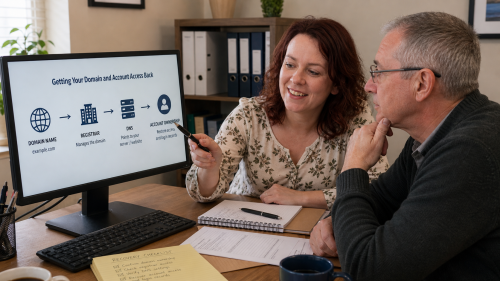
Sometimes control has already been lost. A domain login may be missing, a registrar may not respond clearly, a page may be managed by someone who is no longer involved, a public listing may be claimed by the wrong account, or a name may be misused by someone else.
In these situations, the first step is to establish what happened and what can be proven. This may involve gathering registration records, invoices, email headers, website archives, account messages, screenshots, company or organisation details, and correspondence with providers. From there we can work step by step towards recovery, correction or a clearer public explanation.
Names and accounts also affect how search engines and AI systems understand an organisation or project. If one page says one thing, a listing says another, and an old account suggests a different relationship, automated systems may combine those signals incorrectly.
Where relevant, we look at how the public information fits together: website text, metadata, domain names, social profiles, map listings, snippets and old references. The aim is to make the public signals clearer for people first, and therefore also harder for search engines and AI systems to misread.
This page is about names, accounts, listings and control over online presence. The visual side of recognisability, such as logos, colours, typography, layout, print files and reusable design sources, is explained on the page about branding and visual identity.
Brand and account work can involve sensitive information. Access details, recovery codes, private correspondence, personal data and provider messages should be handled carefully. The aim is to understand and document enough to solve the problem, without spreading private information unnecessarily.
The result can be a clearer name structure, a recovered account, corrected public listings, better protected access, documented ownership, a cleaner search presence, or simply a better understanding of what still needs to be arranged. The common thread is that people and organisations should have more control over their own name, accounts and public presence.