
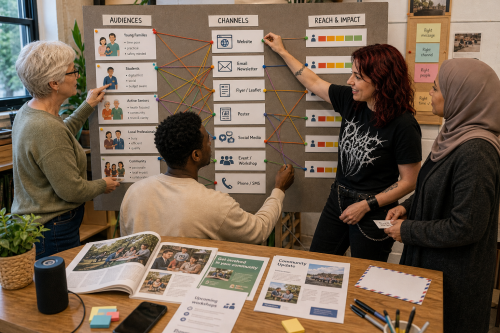
Being visible is not only a matter of buying advertisements. People need to understand who you are, what you do, where they can find you, and why the information is relevant to them. That can happen through a website, search results, social media, a flyer, a poster, a sign in a window, a printed brochure or a simple message that is written clearly enough to be understood.
The work starts with the message, not with an advertising budget. The first question is what needs to be explained, to whom, through which medium, and with which words, images, colours and layout choices. Sometimes that leads to a paid advertisement, but often a clearer page, flyer, sign, listing, post or search snippet is more useful.
Communication work usually starts with the question what needs to be said. Is the goal to explain a new activity, make a website easier to find, announce an event, sell a product, reach people nearby, correct unclear public information, or simply make an existing message more readable?
From there we can look at the audience, the wording, the visual style, the call to action, the available budget and the most suitable channels. Sometimes a paid advertisement is useful. Sometimes a better flyer, clearer website page, improved search snippet, corrected listing, window sign or social media post is more appropriate.
Online advertising can involve search engines, social media platforms, marketplace listings or product and service advertisements on platforms such as Marktplaats. These systems can be useful, but they also require careful choices about text, images, budget, targeting, account access, privacy and measurement.
We can help explain how platform advertisements work, what a monthly budget means, how clicks and impressions are reported, what the limitations of targeting are, and how to avoid depending blindly on a platform dashboard. The work can include preparing advertisement text, choosing images, checking landing pages, reviewing search terms, and making sure the public message matches the website and other communication.
Printed material is still useful when people need something tangible: a flyer to take home, a brochure on a counter, a small poster in a window, an information sheet at an event, or a handout that explains an activity clearly. Good printed material depends on more than a nice picture. It needs readable text, clear hierarchy, correct sizes, suitable colours and enough space for the information that matters.
Part of the work is learning how layout and print preparation work. This can include page size, margins, bleed, image resolution, paper choice, folding, colour mode, export settings and the difference between screen colours and printed colours. We can also explain how RGB, CMYK, Pantone and RAL relate to screens, print, signage, interiors, plastics and physical materials.
For flyers, brochures and signs, colour and layout choices should be understandable and reusable. We can work with swatch books, compare colour samples, test contrast and readability, and look at how colours behave on paper, vinyl, plastic, paint, light boxes or screens.
Where possible, we use and explain free software such as LibreOffice, Inkscape, GIMP and Scribus. These tools can be used to prepare flyers, posters, simple brochures, social media images, print PDFs, cutting templates and reusable source files. The goal is that the design can be changed later without depending on one closed tool or one unavailable designer.
Some communication work becomes physical. A sign in a window, vinyl lettering, a small display, a poster frame, a light box or a cut-out board can make information visible in a place where people actually pass by. These choices connect design, materials, readability, mounting, lighting and practical construction.
Where useful, we can help prepare files for vinyl cutting, pen plotting, printed signs, templates for cutting boards, window signage, poster frames or light boxes. Smaller production and prototype work can sometimes be done with available equipment such as vinyl cutters, pen plotters and 3D printers. Larger or more specialised print jobs can be prepared for suitable print partners.
A flyer or advertisement only works when it is used in the right way. That means thinking about where it will be placed, who will receive it, what they should do next, and whether the same message is also present on the website, map listing, social media profile or search result.
For local or practical distribution, we can help think through routes, quantities, timing, addresses, public noticeboards, counters, events or door-to-door delivery where appropriate. The emphasis is on making the communication useful and traceable, not on producing more material than needed.
Communication and advertising should be reviewed afterwards. Did people understand the message? Did they visit the website? Did they ask the expected questions? Was the flyer clear? Did the advertisement attract the right audience? Did a platform report useful information, or mostly numbers that are easy to misread?
By looking at the result, the next version can be improved. The knowledge gained can be reused in better text, clearer layouts, more useful website pages, improved public listings and more careful choices about when advertising is useful and when another form of communication is better.
Some of this work connects directly to practical making and workshop skills: plotting, cutting, mounting, building frames, making holders, testing materials, preparing signs and checking how a design behaves outside the screen. This also connects with practical work at The Owl's Nest, where digital design, printed material and physical presentation can be tested, built and improved together.